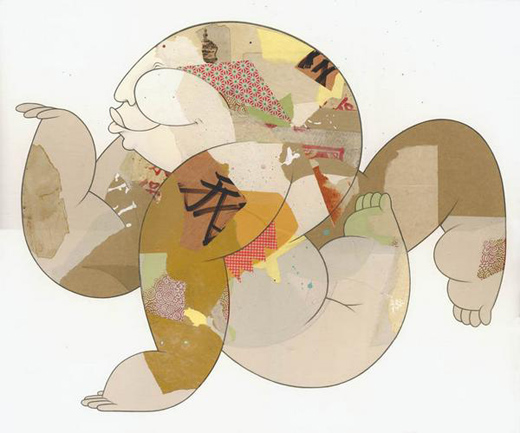
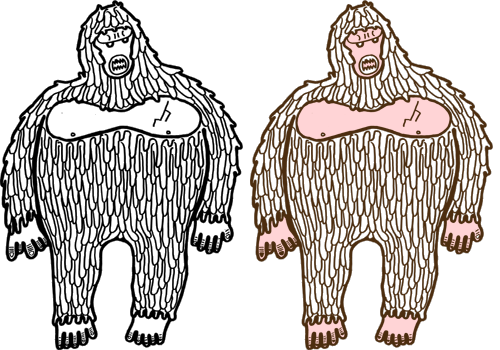
Peter Taylor is a painter and illustrator from Vancouver, Canada, known for his plump tattooed forms. With a background in graffiti, Taylor has continued to work in large scale. His technique with acrylic airbrush is very similar to that of spraypaint, and the large scale allows him to retain many of his approaches to paint handling and layout, but to increase the level of detail to a large degree.
Applied to the relatively simplistic and repeating character shapes, Taylor’s paintings evoke a sense of balance and complexity, contemplation and playfulness.
A mini sketchbook of thoughts / explorations on an emerging movement I see manifesting in the current visual culture of internet design, that for lack of a better term I’m calling “Nu Memphis”.
So I’ve asked this in the past, and never fear, I have EACH and every idea and suggestion written down in a notepad, but I’m going to ask it again today!
I’m going to make a cocktail tonight and photograph it for tomorrow. For what game should be cocktail be based? Vote on our Facebook page.
Thank you all for your ideas and support, and if you have drink recipes and photos of your own, keep them coming! Send them to us on our email.
——————————————————————————————-
Creep (Starcraft II cocktail)
Ingredients: 2 cl Bols Blue
2 cl Sour Raspberry
2 cl Gin
4 cl Apple Juice
Chopped Berries
Directions: Shake all ingredients with ice. Pour into a rocks glass.
“Well done, Cerebrate! What I have wrought this day shall be the undoing of my enemies. Let not a Terran survive!”
In 1852 a group of typesetters and printers in New York began organizing what would become the International Typographical Union. They were reacting to the difficult working conditions that faced many industrial workers at the time. Eventually, they negotiated a 40-hour work-week and other benefits which would become standard across all industries. Today the typesetting profession has virtually disappeared. ‘Typographical labor’ is now performed by graphic designers.
The working conditions we face are different than the ones workers faced 160 years ago: Typesetting/graphic design work has shifted from ‘trade’ to ‘creative’ work, and from industrial to immaterial labor. We don’t punch a clock or go to work at a factory. Instead our workplace is wherever we can set up a laptop. In a world where mobility and flexibility have become the norm, the concept of a 40-hour work-week has eroded into a life where work and leisure time blend into one another in an endless cycle.
We are reviving the I.T.U. name in 2010 as an homage to the original mission of the International Typographical Union. However, we are not forming a labor union (nor a studio), but a platform through which to explore and question the conditions of typographical and creative labor today. We do not necessarily see our clients, or even commercial work, as the ‘enemy’ because we see that they have their own problems. If there is an enemy, it is the situation of post-Fordist capital itself and the constantly shifting demands of the market. This is the condition we are resisting.
Our union is flexible and casual, a shifting support network of friends working together, that allows us to react differently to each project. Through our union we examine the way that graphic design work is performed today — the relationship between money, time, clients, designers, and technology — and we shift things a little bit each time. Like the radical typesetters of 160 years ago that we are aligning ourselves with, we believe that it is time to re-tool the current production model so that it is better suited to the needs of today’s typographic laborer.
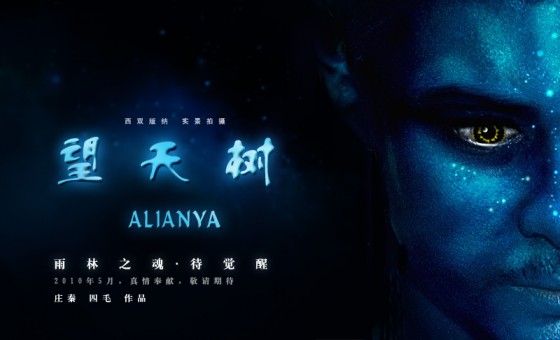
This is a photostory posted on the Tianya BBS that “borrows inspiration” from the recent 3D CGI blockbuster “Avatar” to tell a similar story of “man vs nature”. It appears to be an advertisement for tourists to come to Xishuangbanna, China as this certain locale is touted to have served as an actual inspiration for Avatar as well as having been the one place in China that looks the most similar to Pandora, the fictional moon paradise where the 10 tall blue-skinned Na’vi live.
This use of the movie Avatar to promote tourism in China is not new. In fact, the BBC had reported that the Southern Sky Column in Zhangjiajie, Hunan province, had changed its name to the Avatar Hallelujah Mountain as a way to attract tourists (a claim reportably later denied by officials).
While it looks like a movie, the stills are so heavily Photoshopped and art directed that these are not likely to be movie stills.
Netizens are on the whole very supportive of this post, in no short part due to the insinuated nudity shown by the lead actress.
Here is a little re-cap of the Reset Festival, in San Diego, CA. only a couple of weeks ago, featuring music acts by Flying Lotus, Hatiras, Bassnectar, Dj A-Track, Steve Duda, 12th Planet & more, but from the perspective of the video artist. Who’s often working in the dark, away from the spotlight.
I’ve been producing electronic music since before I started doing graphic design, and I believe that with Vjing I was able to merge both disciplines and in some way, taking graphic design to a performance level, this to me, is the new record cover (or what’s left from it).
With the help of dedicated controllers, and softwares like Modul8, the possibilities are limitless, and the freedom to improvise, help make every performance different.
A trip on the train would go like this:
1.Get to the station and board the waiting roof-car.
2.The train passes the station and your roof-car is picked up.
3.You get off the roof-car and sit down on the main train below.
4.Approaching your stop, you board the roof-car.
5.As the main train passes the station the car stops and you get off.
Simple and brilliant, just gotta make sure all the kinks are worked out first.
Theme:「Xin-信」
Literally meaning “message” or “letter,”「Xin-信」represents a primitive means of communication. Today, however, it encompasses many more dimensions than ever before, as illustrated by words such as Xin-xi (information); Xin-nian (vision); Xin-ren (trust); Xin-yong (creditability) and Xin-xin (faith).
In 1972, the UN General Assembly introduced World Development Information Day to draw public attention to development problems and the need to strengthen international cooperation in order to solve them (Resolution 3038). The Assembly eventually decided that this should coincide with United Nations Day on October 24, also the date for the adoption of the 1970 International Development Strategy. October 24 is also the first day of XIN Beijing. Like designers, the General Assembly believed that improving the dissemination of information through communication design and mobilizing public opinion, particularly amongst the younger generation, would lead to greater awareness and cooperation in solving the problems of international development.
The Art Of Conversation:
London—Berlin showcases specially created original work from a selected group of 20 young and established designers and design studios and exhibits the results in both London at Idea Generation Gallery and Berlin at Program Gallery.
From January to March 2010 the participants, 10 London based design studios and 10 Berlin based design studios, played a visual game of Chinese Whispers. Each participant was presented with a work/idea from the previous participant in the chain via a Skype chat, they then had 3 days to interpret it and forward their results to the next participant.
These responses could take any form; from sculpture to performance, photograph to text.
Far from being a simple showcase of each individual’s work, this is a dynamic collaborative process in which the creatives engaged with and reinterpret concepts and designs generated by their fellow designers. The exhibitions are an exemplification of the design process itself laying bare the ways in which ideas are realised visually through a multiplicity of techniques, materials and cultural influences.
…moreAs such the curators hope to demonstrate the different approaches and aesthetics of London practitioners and their Berlin based counterparts whilst facilitating a complex mash up of the two. We hope that this resulting body of works demonstrates that creativity is never predictable and infinitely varied.
Additionally to the created pieces of artwork, each participating studio has designed a Limited Edition two colour screen print in response to their involvement in the process.
This will further allow the designers to showcase an uninhibited style and will act as a point of reference for the work they have produced during the The Art of Conversation: London—Berlin. These prints will be available for purchase both at the exhibitions and online, see the banner at the top of this website to take you to our online shop.
“We hope the show is a journey allowing the viewer to follow the tangential ideas of the participants. Often exhibitions only show finished works, and the process of reaching them can be just as interesting. This show is unique in that the finished pieces are both the inspiration for the work and the work itself”