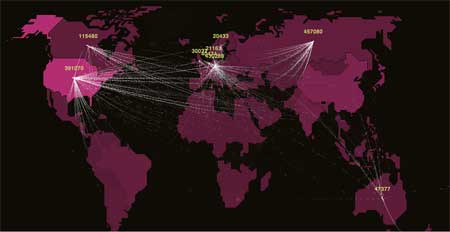

Human Flow’s aim is to “visually and interactively mapping global migrations in a bid to understand its causes.” Why do you think that there is a need to map migration in a new way? Isn’t there already online instruments which do just that? Which new elements does HF brings to the issue?
Most of the online instruments tend to concentrate on particular moments on migration, showing a partial view of the problem. This happens because global migrations are strongly connected with the current situation (economical, political, social, etc.) of each sending and receiving country, and that produces one of the usual ideas of the migrant: they migrate because they are poor, or their home counties are insecure. But even if this is partially true, I think that seeing this migrations from an historical point of view can raise interesting questions: Why did migrations to Germany become so strong from mid nineties, even from European citizens? Why is so important for Latin American people to go to the United States? Why are Africans risking their lives crossing the ocean to be here? Why were migrations in the eighties so different from today’s migrations?
You must be logged in to post a comment.