
Do you think a lot of architecture has no purpose?
AW: Let’s put it this way – if there is a purpose, it’s one I don’t admire. There is too much waste, the language is often unclear, and frequently the architect’s efforts are not intelligent. Architecture is a moral-political question, not just a technical one. The desire to build is a basic instinct, a necessity if one is to survive in nature. Today architecture has become a profession taught in universities by instructors whose courses are devoted to making architecture crazy. All those students want to be stars. They are far less interested in how to survive. Architecture can be intelligent only when it’s true to its fundamental nature.
Your architectural career started with your own house.
AW: Yes, but initially I wasn’t aware of what I had done. Later, Shigeru Ban saw this house and said the only architect in China is Ai Weiwei, blah blah blah. His words made me more conscious of what I was doing. After that, many friends came asking for help. Often I said yes, because the problems I’d confronted could all be solved with basic common sense. My work doesn’t look special. It doesn’t require a great deal of special training. It’s really all about making moral and aesthetic judgements rather than technical ones. During the past seven years, we’ve done about 40 projects, including housing, landscaping, a stadium, a cultural facility, a bar and a restaurant. If it can be called ‘architecture’, we do it.
Would you say the design of your house is fundamental?
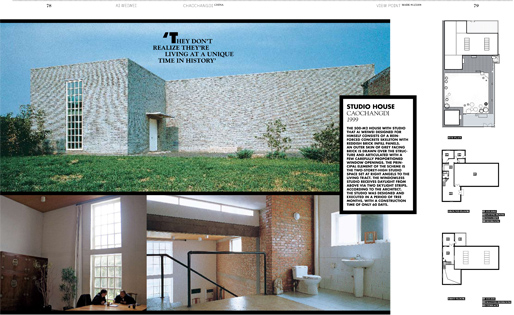
AW: I’d call it ‘essential’, because I used minimal materials to create a maximal volume. It has a very practical layout and not much interior design. The architectural language isn’t trendy. Maybe it’s become trendy because you live in it. It has become fashionable, and it’s been copied in this area. When it was being constructed, however, the farmers who helped build it thought it wasn’t finished. They didn’t understand why I didn’t want any interior design. I had to tell them I’d run out of money.
How would you describe your architecture? Do you talk about style?AW: No, I don’t talk about style, but if you deny all styles, your style emerges anyway. My style is to reduce all superfluous effort – to do the work in an essential and necessary way. In discussing my projects, people use terms like ‘minimalism’ and ‘purity’, which are incorrect. The work is essential, and the results are rooted in that essentiality.
Speaking as both artist and architect, what are your thoughts on contemporary China?
AW: Currently China is at a stage I would call the most extreme condition that humans can experience. Culturally, though, this condition is like a desert absolutely lacking in new philosophies, new morals, new aesthetics – all the aspects that should accompany the kind of activities taking place. It’s a sad story and one I often talk about, but nobody else seems to be discussing these matters. And that’s disturbing. Chinese architects are simply blind or mentally retarded in some way. They don’t realize they’re living at a unique time in history. There is no intellectual discussion, no meaningful practice. I wrote a few articles on how architects should change and be more conscious of what they’re doing, urging them to make work that addresses the current state of affairs – to consider density, speed, scale and unfamiliar building regulations. Only then can a meaningful new architecture be realized. It’s wrong to make an incorrect analysis of Western architecture or to simply copy Western buildings.
February 24th, 2009 - 6:42 am
“Chinese architects are simply blind or mentally retarded in some way.”
Nice, but actually good point, I feel the same way about Korea (in general)