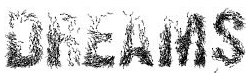
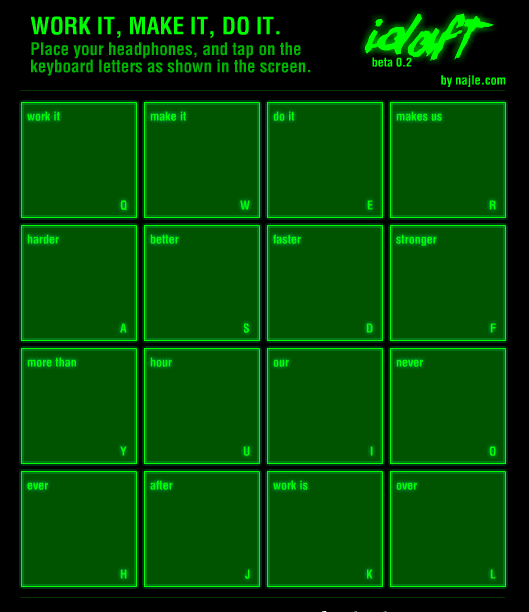
This is a kind of Chinese poem with a circular structure which you can read from any word and it will make sense. So it’s like, you can start on the second word and end on the first word and it becomes another poem with a different meaning.
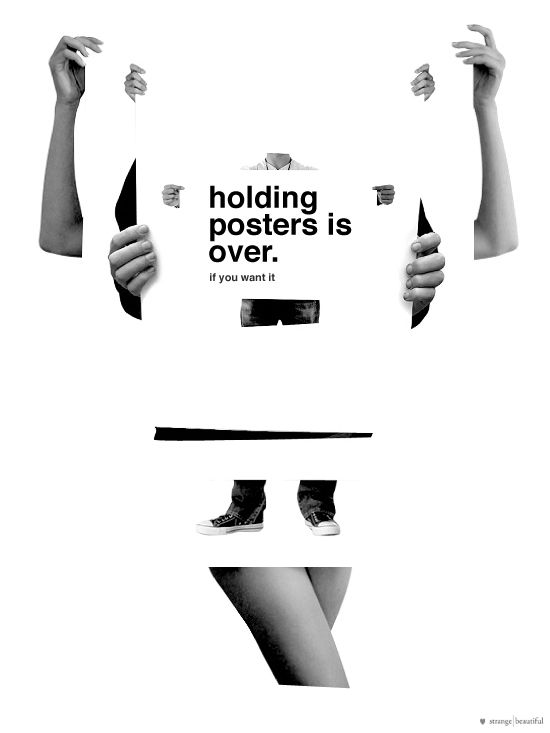
WRK/PLY Conference will be a day long creativity conference at the end of March, challenging the conventions of work and play. The WRK/PLY experience serves up a 50/50 split. Our panel of six speakers, each specifically chosen for his or her success blending play into their work lives, will construct interactive elements designed to emphasize the value of constructive play.
We took to the hills of Wales armed to the teeth with sheep, LEDs and a camera, to create a huge amazing LED display. Of sorts. For more info search for samsung LED TV or visit samsung.com/LED
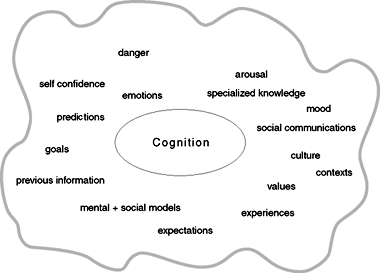
There is an Aristotelic tradition in cognitive psychology, information design and artificial intelligence, to understand human information processing as a mechanism, that is, as a complicated system, ultimately explainable on the basis of the understanding of every one of its multiple components and their interactions. Instead of looking at human information processing as a complicated system, I propose to look at it as a complex system, distinguishing for this paper the complicated from the complex; the first being composed by a high number of discrete parts with many interconnections: as in a computer circuit, the second being an integrated system where everything affects everything: as in the relation between two people. Since I have chosen as my theme the contextualization of cognition with other human factors, I will be dealing with the complex, and I will therefore not attempt to enumerate parts and connections; I will instead concentrate on certain insights about field interactions that I hope will reposition our understanding of mental processes, moving it from an analysis of logical steps to the exploration of the influence that contexts have on human cognitive performance.
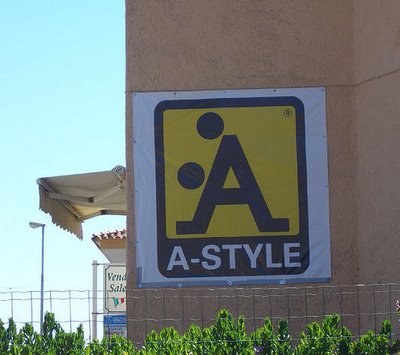
At first glance, the logo above might seem like just a boring piece of concept-less design. Honestly, that’s bad enough.
However, upon further inspection, if you really get on in there, you’ll see that, yes, it is actually a sexual position masquerading as a logo.
Now you have to ask, “How on Earth does this make it through any type of approval process?” It takes me days, sometimes weeks, to get people to move on decisions. They rehash every little detail, until I think my eyes are going to bleed from debating the merits of cerulean text on navy over powder on black. Everyone has to take a look at it. Everyone has to give input. I don’t imagine that other people’s processes are much different.
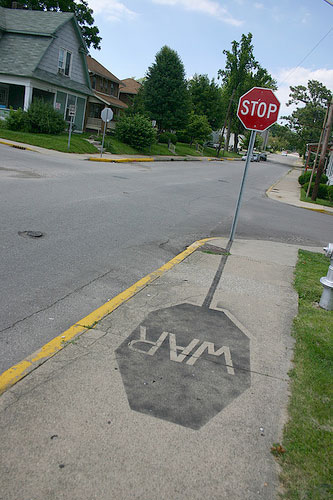
this witty piece of stencil grafitti protesting the war was spotted in bloomington、indiana、USA.
‘the piece itself is was stenciled on the floor using a shadow cast by a light post at night、and later carefully sprayed with a 『camouflage black』 can.’
my friend from W+K recently did this in Portland!
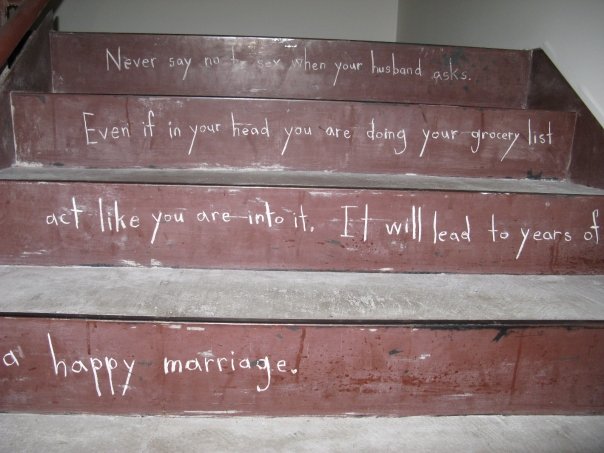
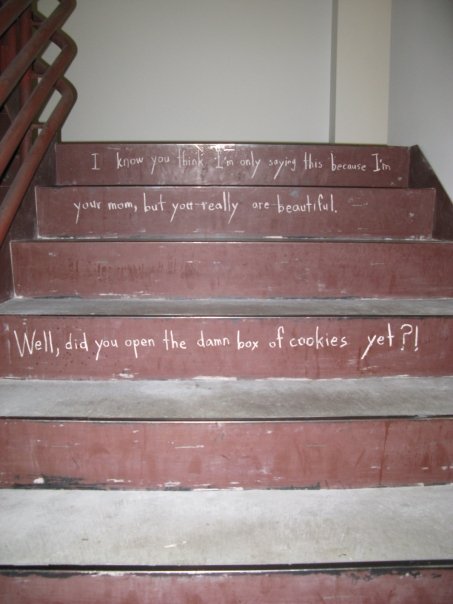
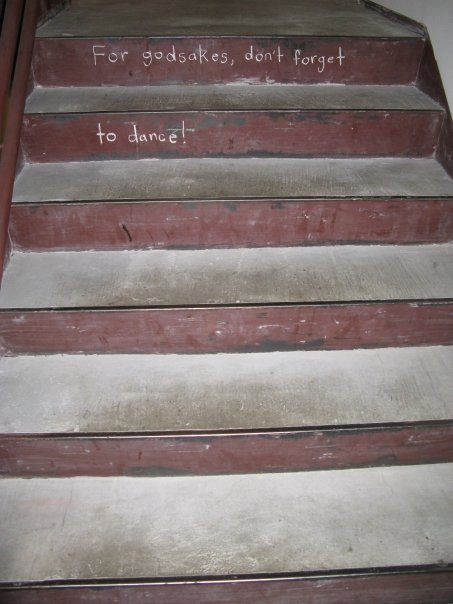
Quote from Chean:
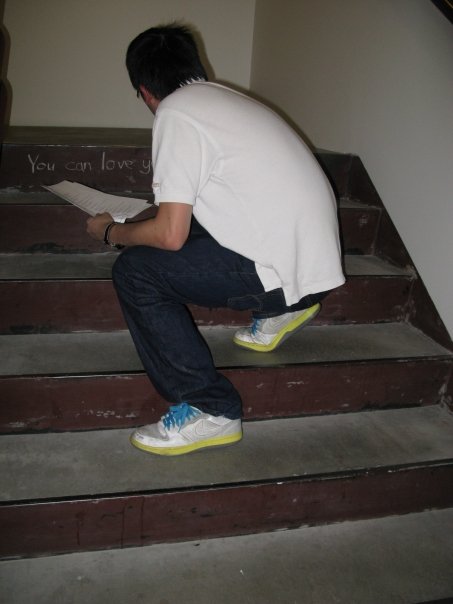
Was an idea from mark and I. We both were bored and want to do
something to encourage people walk the stair.
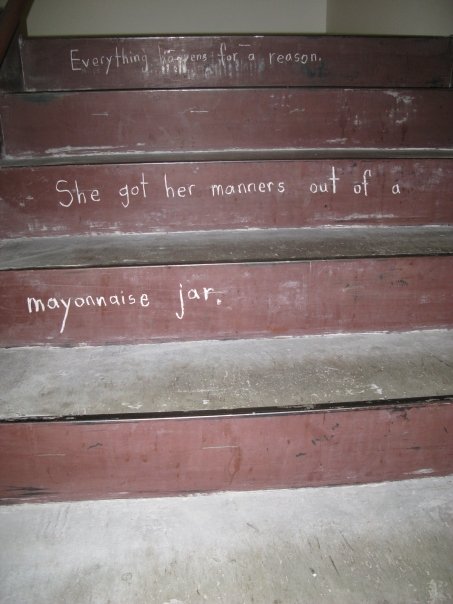
Also was inspired by the project “learning to love you more”. So we
collect information from wk-ers and write in on stair. These are
favorite quoted from parents.
This has made me think that indeed, when it comes to fighting censorship, the Charter has an insurmountable flaw: it is a document. Therefore, its title and content are fixed and it is extremely easy to locate by a bot. Worse even, in this era of the internet, the authors have commited the mistake of giving their Charter 08 a searchable term title. Any internet conversation where the Charter comes up, even if the contents are not copied, is sure to attract the Censor’s eye.
It might sound ridiculous at this point, but I am dead serious: The Charter 08 should be named Wang. Or Zhang or Liu, any other term that is not exclusively related to it and therefore cannot be banned. Two centuries ago, the first Spanish constitution of 1812 was nicknamed by the people “La Pepa”, a popular name for a girl that many intellectuals scorned at the time. Two years later, during the reign of autocrat Fernando VII, this name became extremely useful to dissidents to acclaim the Constitution without risk to their lifes, with the famous slogan “Viva la Pepa!!”
comment: it’s kind of cool to think of it as guerrilla warfare, how to conceal something by making it formless and undefinable, or making it non-exclusive and having multiple identities and unsearchable. By not giving something a definite name, the entity lives in multiple locations and exists more as a movement rather than an object. Think of how terrorists are hard to detect because they look like civilians and are not dressed in uniform. This kind of warfare is hard to fight because the enemy cannot be located. How do you strike an enemy that is dispersed in a sea of people without killing everyone else? The internet age has definitely created a different battle for the world today.
Grass Mud Horse, a mythical creature from a comedy Youtube children’s song, has apparently spread like wildfire through China’s cyber space. The name in Chinese is a pun on a much ruder epithet involving intercourse with someone’s mother.
To Chinese intellectuals, the songs’ message is clearly subversive, a lesson that citizens can flout authority even as they appear to follow the rules. “Its underlying tone is: I know you do not allow me to say certain things. See, I am completely cooperative, right?” the Beijing Film Academy professor and social critic Cui Weiping wrote in her own blog. “I am singing a cute children’s song — I am a grass-mud horse! Even though it is heard by the entire world, you can’t say I’ve broken the law.”
It has also raised real questions about China’s ability to stanch the flow of information over the Internet — a project on which the Chinese government already has expended untold riches, and written countless software algorithms to weed deviant thought from the world’s largest cyber-community.”
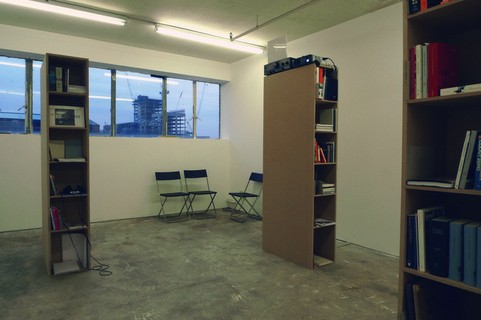
FormContent is a curatorial project space, initiated in 2007 by Francesco Pedraglio, Caterina Riva and Pieternel Vermoortel in London’s East End. Its mission is to create a space in which to experiment with ideas and exhibition formats, to foster an active collaboration between artists and curators while challenging their roles.
The Lab represents Rockwell Group’s mission of making. It is a mixing chamber of ideas encompassing digital interaction design, the material and image library, modeling and prototyping resources. The Lab provides a space for the 250 designers at Rockwell Group – who are also artists, sculptors, chefs, opera singers, architects, playwrights, and set designers – to collaborate to create a cross-disciplinary approach to design, and generate a cross-pollination of ideas. The ambition of Lab is to explore and promote understanding of the relationship between human interaction with technology, and its effect on experience. This activity includes: science and technology consultation, in house design and creation of interactive environments/objects, and maintaining networks of technology solution providers.