



RGB Studio
December 8th, 2007
clean site and nice work of Rob Brearley


IPSE…be amazed.
December 8th, 2007
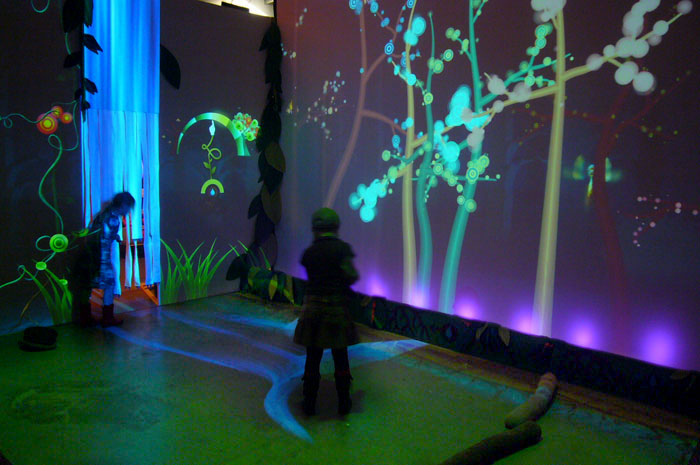
Dezzie Dimbitsara, an alumni from the Frank Mohr Instituut’s MFA program in Interactive Media and Environments (IME), has been creating appealing installations and generative works, that can be seen on her website (http://dezzie.net).
Her IPSE installation allows people to visualize “the invisible” links between each other. The visual depicts those links depending of the way people interact in the space. A video tracking program is used to locate each person and a projection on the ground shows those links. Distance and time are used as parameters to define the way links are moving in the space. The way links are created is inspired by rhizome patterns.
As the author explains: “My aim is to create a place, which makes us remember, the obvious equality between human beings (obvious, but it is necessary to be remembered about it). By this equality I mean, that it is important to see again in the stranger, the alter ego. I do believe that the rehabilitation of the gaze, the simple awareness of the other as an equal and not as a threat is a first step to establish better relationship in social life.”


Muonics: Interactive work of Theodore Watson
December 6th, 2007

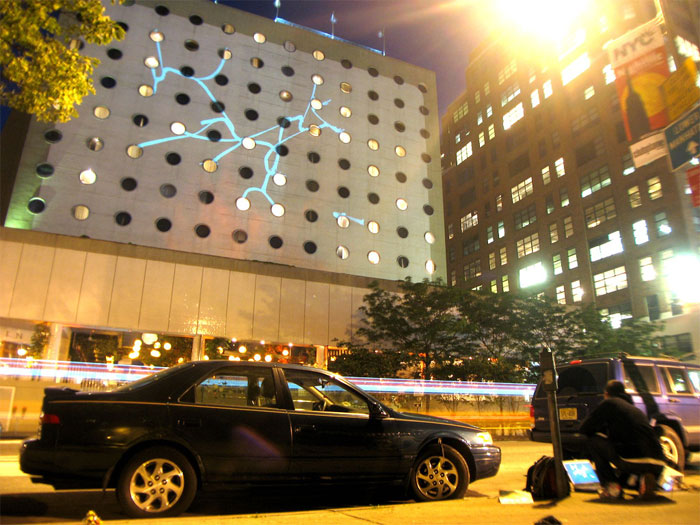
Interesting Concept.
December 5th, 2007

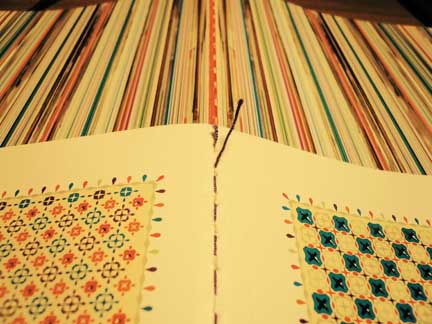
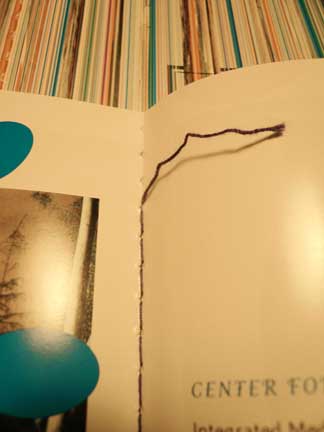
Investigation of an alternative binding method
December 5th, 2007
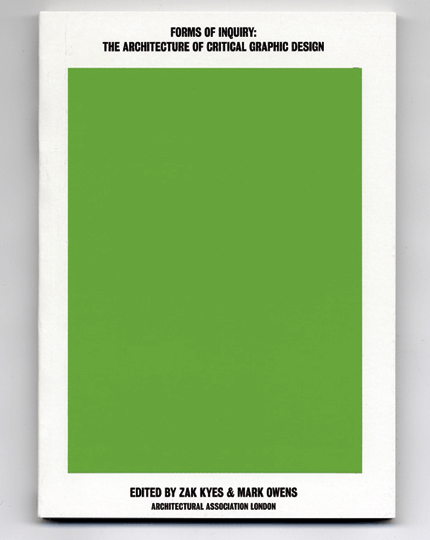
Just got this catalog in the mail today, it’s sew machine bind, kinda interesting. Chris just got a new sewing machine we got him for his birthday haha. I’ll show you the print later, I took photos at night and it’s poor quality. These will have to do for now.

Site of the Year
December 3rd, 2007

female soldiers
December 1st, 2007
Takashi Murakami
November 30th, 2007
My film professor mentioned that the cuteness of Japan arised as a result of World War II, that after the bomb was dropped in Hiroshima, Japan became a child of America when American forces occupied Japan. As such, Japan has this child-parent relationship with America (which is still present today), where Japan looks to America for ‘approval’, and so a ‘kawaii’(cute) culture grew out of the Japanese people, resulting in manga, anime and toys like Hello Kitty. Professor Spigland also mentioned that there’s a whole book on this, titled something like ‘After Hiroshima’ which talks about the culture in post-war Japan. I’m curious if ‘cuteness’ was ever present in Japanese society before the war, and if it wasn’t, then his point might very well be true, because if you look at Korean or Chinese culture, that ‘cuteness aspect’ isn’t present, even when all three cultures stemmed from the same root.
“The title of T. Murakami’s symposium, held at Yale was called “Little Boy” -derived from the A-bomb dropped on Hiroshima in 1945. The talk examined ideas from TM’s superflat theory e.g. 2-D origins of Japanese pop art coming from the aftermath of LittleBoy and high-low art having no distinctions in Japan, but it also suggests that Japanese pop art didn’t come from the West. ”
—comment left on Murakami’s Youtube video
100 Person Flashmob Randomly Chasing After People
November 29th, 2007
Syntactic ambiguity
November 29th, 2007
For sale: Mixing bowl designed to
please a cook with round bottom for
efficient beating.
milk drinkers are turning to powders
Madonna discussed sex with David Letterman
’twas brillig, and the slithy toves
did gyre and gimble in the wabe
all mimsy were the boroggroves,
and the mome raths outgrabe.
(sentence with no semantics but understood only through syntax)


The Secret Strategies Behind Many “Viral” Videos
November 26th, 2007
No such thing as viral anymore: really interesting tips on how to get your videos more seen. Link
Everyone Forever
November 23rd, 2007

Trees, artificially seperated from nature.
Via Everyone Forever
SpaceCollective
November 23rd, 2007
We are all aliens
Folkert Gorter aka Superfamous.com has left Amsterdam half a year ago to work on a unique multimedia project in Los Angeles “that will offer people a new way of thinking” and “that will let them take part in the evolutionary process of mankind”. The sneakpeak he offers me proves his he may just keep his promise! The thirty year old designer (formgiver in the case of Folkie - translator) has web-cred, since he started, together with Jason Kristofer, the website Newstoday.com. This elegant portal for the online designcommunity attracts roughly 11 million pageviews per month. Gorter’s new project is Spacecollective.org. Yet still hidden behind password protection, the launchdate is projected for 2007. De site will be a “non-profit, cross media information and entertainment channel for post-ideological, non-partisan, forward-thinking terrestrials”. Buzzword bingo!
In webisodes of three minutes each - non-linear minutes even, in which the focus jumps from moving image to streaming typography and short facts that will offer a psychedelic perspective in just a blink of an eye - Folkert creates, together with partners René Daalder (Bright issue 06) and Aaron Ohlman, a new version of the gold-anodized plaque that was compiled by Carl Sagan for NASA as a representation for human kind. The plaque (Bright issue 02) was shot into space aboard the Voyager, today still flying with a velocity of 1 million miles a day, looking for an exchange with extraterrestrial intelligence. From this analog plaque, named Murmurs of Earth, Spacecollective will create their own variation, this time allowing everybody to participate, without the censorship such as the brushing away of the male and female genitals at the time. Each member will get its own spacecapsule, for which the member can create messages that will be beamed to the stars monthly. This way everyone can, to quote the creators, “create its own digital immortality”.
SpaceCollective will be a trilogy. Apart from the website a reality-tv series is in the pipeline, in which groups of students, grocery-store employees or ex-astronauts will work on a capsule for a period of time; and a speculative Sci-Fi documentary about the state of the future of mankind. What is striking about the message is the notion that “the most hopeful sign of intelligent life on earth is the rise of the internet”. The creators look upon each human being as a neurone and the Net offers the synapses that will enable us to make connections. A new collective brain can bring us to the next level of human evolution, a development that is perceptibly increasing acceleration, and that will eventually, around 2060, lead us to the coming Technological Singularity. Meanwhile Gorter is all set. He thinks of himself as a testpilot who tests concepts to ultimately return them to improve the condition of mankind.
By Adam Eeuwens, Los Angeles
for Bright Magazine, Issue 10.
Selling dreams
November 23rd, 2007

Proudly powered by WordPress. Theme developed with WordPress Theme Generator.
Copyright © _dreams. All rights reserved.
Copyright © _dreams. All rights reserved.