by Sol Lewitt
- Conceptual artists are mystics rather than rationalists. They leap to conclusions that logic cannot reach.
- Rational judgements repeat rational judgements.
- Irrational judgements lead to new experience.
- Formal art is essentially rational.
- Irrational thoughts should be followed absolutely and logically.
- If the artist changes his mind midway through the execution of the piece he compromises the result and repeats past results.
- The artist’s will is secondary to the process he initiates from idea to completion. His wilfulness may only be ego.
- When words such as painting and sculpture are used, they connote a whole tradition and imply a consequent acceptance of this tradition, thus placing limitations on the artist who would be reluctant to make art that goes beyond the limitations.
- The concept and idea are different. The former implies a general direction while the latter is the component. Ideas implement the concept.
- Ideas can be works of art; they are in a chain of development that may eventually find some form. All ideas need not be made physical.
- Ideas do not necessarily proceed in logical order. They may set one off in unexpected directions, but an idea must necessarily be completed in the mind before the next one is formed.
- For each work of art that becomes physical there are many variations that do not.
- A work of art may be understood as a conductor from the artist’s mind to the viewer’s. But it may never reach the viewer, or it may never leave the artist’s mind.
- The words of one artist to another may induce an idea chain, if they share the same concept.
- Since no form is intrinsically superior to another, the artist may use any form, from an expression of words (written or spoken) to physical reality, equally.
- If words are used, and they proceed from ideas about art, then they are art and not literature; numbers are not mathematics.
- All ideas are art if they are concerned with art and fall within the conventions of art.
- One usually understands the art of the past by applying the convention of the present, thus misunderstanding the art of the past.
- The conventions of art are altered by works of art.
- Successful art changes our understanding of the conventions by altering our perceptions.
- Perception of ideas leads to new ideas.
- The artist cannot imagine his art, and cannot perceive it until it is complete.
- The artist may misperceive (understand it differently from the artist) a work of art but still be set off in his own chain of thought by that misconstrual.
- Perception is subjective.
- The artist may not necessarily understand his own art. His perception is neither better nor worse than that of others.
- An artist may perceive the art of others better than his own.
- The concept of a work of art may involve the matter of the piece or the process in which it is made.
- Once the idea of the piece is established in the artist’s mind and the final form is decided, the process is carried out blindly. There are many side effects that the artist cannot imagine. These may be used as ideas for new works.
- The process is mechanical and should not be tampered with. It should run its course.
- There are many elements involved in a work of art. The most important are the most obvious.
- If an artist uses the same form in a group of works, and changes the material, one would assume the artist’s concept involved the material.
- Banal ideas cannot be rescued by beautiful execution.
- It is difficult to bungle a good idea.
- When an artist learns his craft too well he makes slick art.
- These sentences comment on art, but are not art.
http://www.altx.com/vizarts/conceptual.html
Filed under: inspiration | Comment (0)
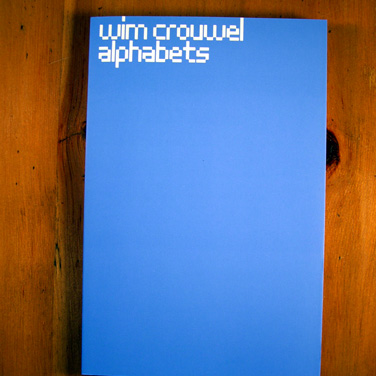
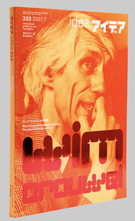
Wim Crouwel is one of the Netherlands’ greatest design icons. He is especially admired for his systematic approach and his creative handling of the shape of letters. Several of his typefaces have been released in digital form: the New Alphabet in three weights, the Fodor and Stedelijk ‘museum’ alphabets, and recently, the entire Gridnik family of letters. Today, young graphic designers pay tribute to Crouwel’s work, which dates back to the late 1950s and 1960s. Now that his typefaces are available to designers throughout the world, we are fascinated by how Crouwel himself applied them in his graphic work and long to better understand the ideas, philosophy and historical contexts of his designs.
Filed under: inspiration | Comment (0)
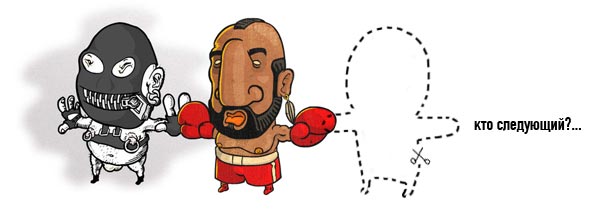
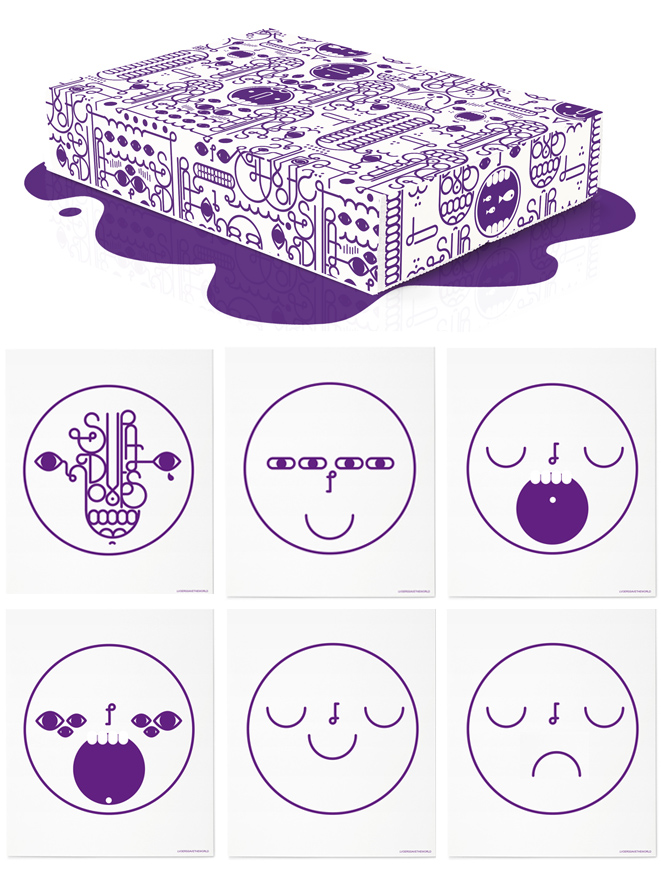
unfortunately the website never came back again. this was the original site that inspired my _friends project. however, i did find one made by the blog writer, who was probably inspired by the same idea.
http://merdanchik.com/x/
they have some nice drawings, and if you notice, some of their artists contributed on _friends too!
Filed under: inspiration | Comment (1)

When my daughter Alison was born, in the tradition of a new parent, I began to photograph her, initially in a separate and private body of work. However, in the process of documenting Alison’s growth, I developed a passionate interest in human relationships and capturing intimate moments in the lives of family and friends.
Filed under: inspiration | Comment (0)
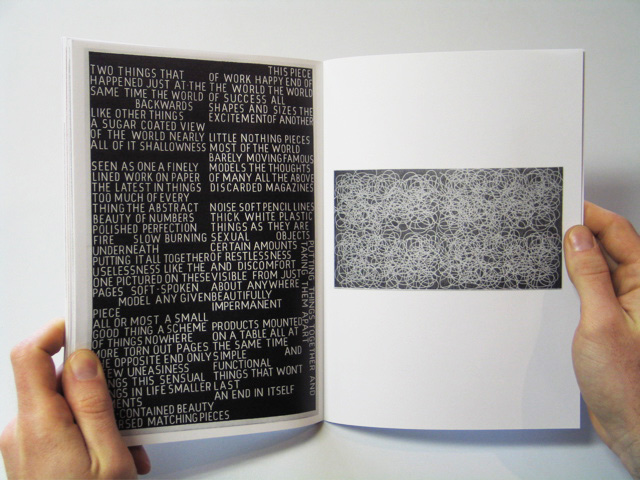
Roma Publications is an independent publishing project, founded by artist Mark Manders and graphic designer Roger Willems. It is used as a platform to produce autonomous publications in close collaboration with a growing number of artists, institutions, writers and designers. Related to the content, every issue has its own rule of appearance and distribution, varying from house to house papers to exclusive books. Until now the publications have editions between 2 and 150,000.
Filed under: inspiration | Comment (0)
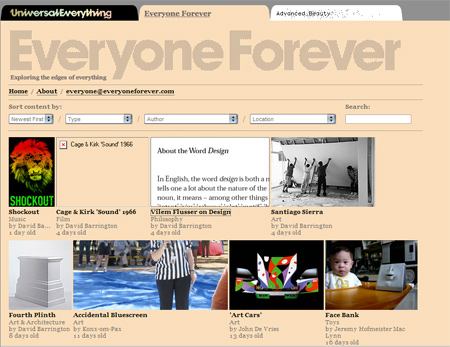
a really good blog about interesting projects.
Filed under: inspiration | Comment (0)

Great example of how a process translate to a final product. I like.
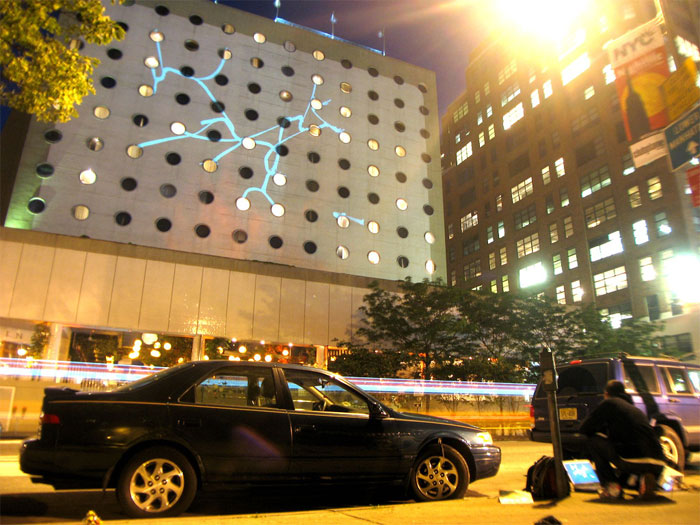
“…The scarf was created when Moving Brands set up a screen of fairy lights in their window and passersby were asked to send messages and drawings via a web interface. The sequence of contributions was then applied to the scarf’s design.”-mocoloco
Filed under: inspiration | Comment (0)
She: I’m thirsty. Do you think that water is free?
He: I dunno. There are lots of people in there, you better hurry.
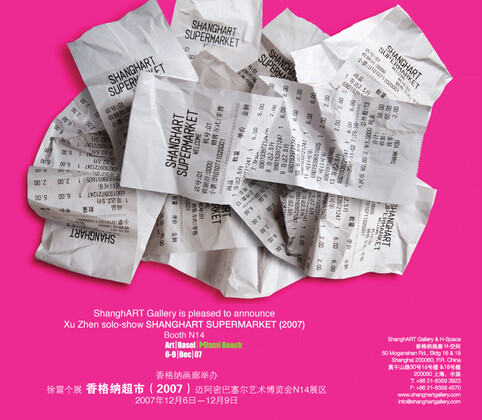
Well, she had to go thirsty. There was no water in the bottles and the empty bottles were not free. Yet the punters were buying. One of the most eye-catching and most talked-about installations at Art Basel was the ShanghART Gallery exhibition, the ShanghART Supermarket by Xu Zhen. A typical Chinese convenience store was carefully set up in the gallery space at the Miami Convention Center, complete with freezer section, grooming products, cashier and register. The only problem was that each and every piece of packaging was exactly that: nothing but the package. The installation began as a fully stocked store, but the shelves were almost depleted by the last day of the show. Consumers and collectors were paying Shanghai prices for:
a) nothing
b) authentic Chinese packaging
c) part of an installation
d) Art Basel souvenirs
e) all of the above
f) none of the above
g) there are no correct answers
The beauty of collectors, consumption and conceptual art.
Filed under: inspiration | Comment (0)
clean site and nice work of Rob Brearley


Filed under: inspiration | Comment (1)
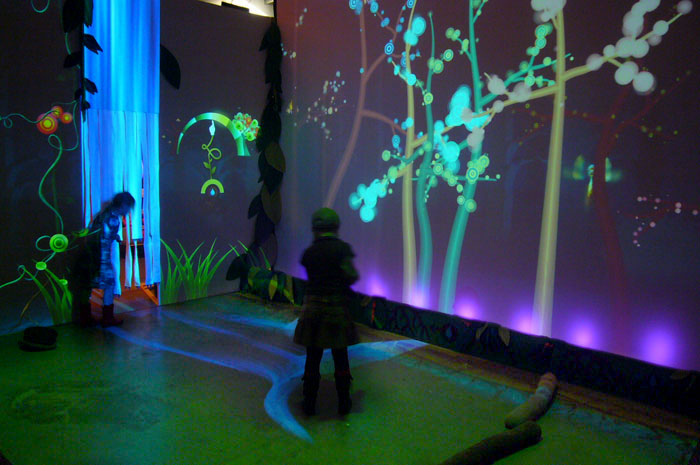
Dezzie Dimbitsara, an alumni from the Frank Mohr Instituut’s MFA program in Interactive Media and Environments (IME), has been creating appealing installations and generative works, that can be seen on her website (http://dezzie.net).
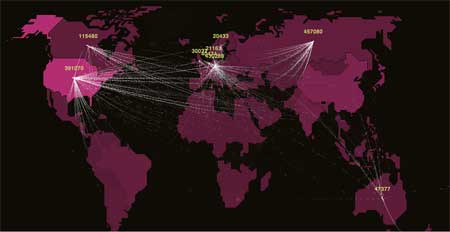
Her IPSE installation allows people to visualize “the invisible” links between each other. The visual depicts those links depending of the way people interact in the space. A video tracking program is used to locate each person and a projection on the ground shows those links. Distance and time are used as parameters to define the way links are moving in the space. The way links are created is inspired by rhizome patterns.
As the author explains: “My aim is to create a place, which makes us remember, the obvious equality between human beings (obvious, but it is necessary to be remembered about it). By this equality I mean, that it is important to see again in the stranger, the alter ego. I do believe that the rehabilitation of the gaze, the simple awareness of the other as an equal and not as a threat is a first step to establish better relationship in social life.”


Filed under: inspiration | Comment (0)
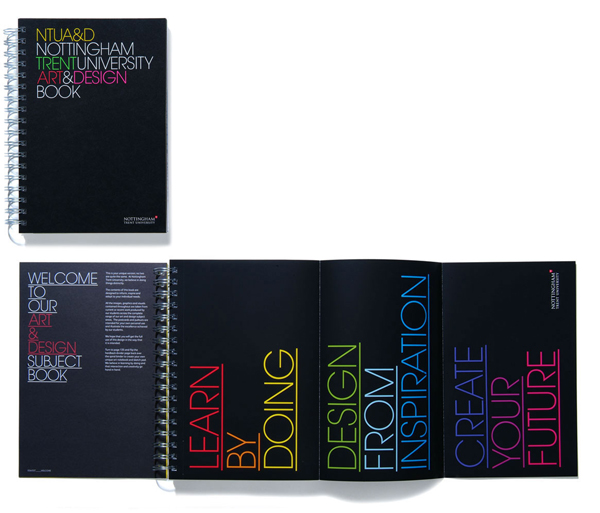
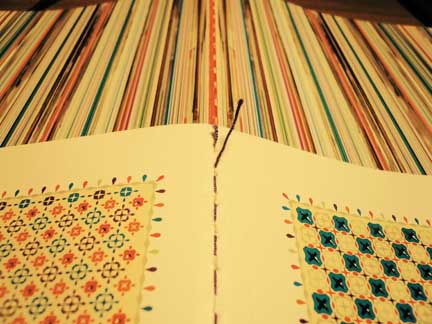
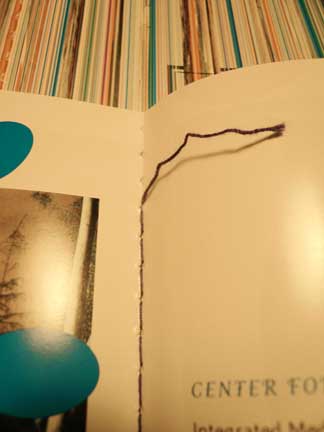
Just got this catalog in the mail today, it’s sew machine bind, kinda interesting. Chris just got a new sewing machine we got him for his birthday haha. I’ll show you the print later, I took photos at night and it’s poor quality. These will have to do for now.
Filed under: inspiration | Comment (0)