read rest of article via 365daysoftrash blog


Pentagram Recasts the Republican Brand for ‘Newsweek’
January 6th, 2009
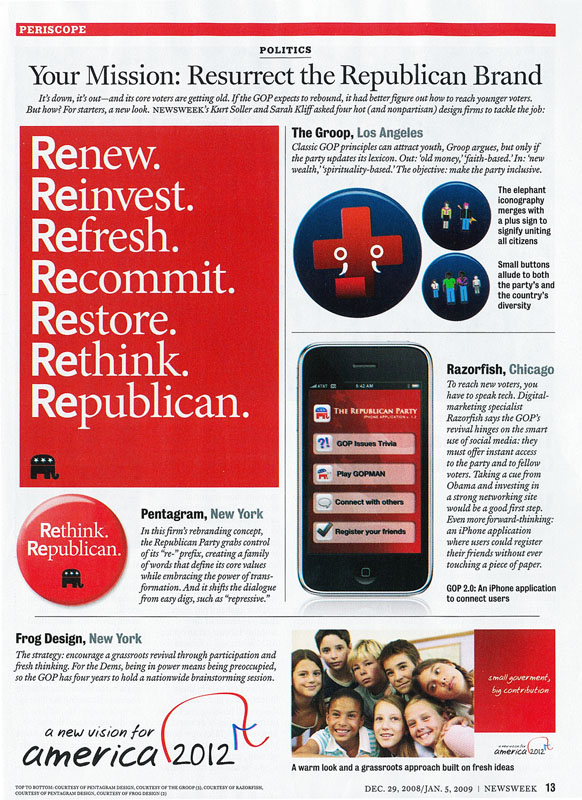
Pentagram was one of four design firms asked to “resurrect” the beleaguered Republican Party brand for an exercise in Newsweek’s special end-of-year issue, on newsstands now. Our concept, designed by Michael Bierut, makes use of the “re-” prefix to create a family of words that define the party’s core values and emphasize the power of transformation.
“The two party system only works when you have two strong parties,” says Bierut, a lifelong Democrat. “This theme isn’t meant to redefine the GOP — another appropriate ‘re’ word — but simply provide a context for that redefinition. The party of Lincoln deserves it.”
http://blog.pentagram.com/2008/12/pentagram-recasts-the-republic.php
Objectified trailer
January 6th, 2009
From the guys who brought you the Helvetica film.
http://www.objectifiedfilm.com/objectified-trailer/
Lucha Loco
January 5th, 2009

I got this in the mail today as a late Christmas present. It’s pretty dope, I am not gonna lie! Check out some more photographs below
The Difference Between Building a Business and Building a Brand
January 5th, 2009
Don’t Confuse the Latter With Celebrity Index
Published: January 05, 2009
Are you building a business? Or are you building a brand? Silly questions, you might be thinking. Naturally, you are trying to do both. But that might be a mistake.What’s good for the business is not necessarily good for the brand. And vice versa.
What’s a brand anyway? It’s a word that stands for something in the mind of prospects. That definition, by the way, is at odds with conventional thinking.
Most managers equate a brand with its celebrity index. The more famous the brand, the more powerful it is. “Making our brand name well-known” seems to be the conventional approach to brand building.
Chevrolet is one of the world’s best-known automobile brands, but how valuable is the Chevrolet brand? Not very.
Chevrolet doesn’t make Interbrand’s list of the 100 most-valuable global brands. Chevrolet, like many other exceptionally well-known names, isn’t worth much because it doesn’t stand for anything.
It’s not just Chevrolet. The U.S. automobile industry markets 14 vehicle brands: Buick, Cadillac, Chevrolet, Chrysler, Dodge, Ford, GMC, Hummer, Jeep, Lincoln, Mercury, Pontiac, Saab and Saturn.
I would guess that every one of these brands (with the exception of GMC) is exceptionally well-known with a recognition score in excess of 90%.
Except for a house or an apartment, an automobile is the most expensive product a person might buy in his or her lifetime. In addition, an automobile has enormous street visibility. These factors combine to give automotive brands a huge advantage in the battle for the consumer’s mind.
It’s not surprising that 11 automobile brands made Interbrand’s most valuable list. But just one of those 11 brands was an American brand. (Ford at No. 49.) The other 10 were European and Asian brands. Why? The European and Asian brands stood for something.
- Toyota (No. 6): Reliable
- Mercedes-Benz (No. 11): Prestige
- BMW (No. 13): Driving
- Honda (No. 20): Reliable (second to Toyota)
- Volkswagen (No. 53): Practical
- Audi (No. 67): Advanced technologies
- Hyundai (No. 72): Cheap
- Porsche (No. 75): Sports cars
- Lexus (No. 90): Luxury
- Ferrari (No. 93): Expensive sports cars
Keep in mind, these are global brands. Volkswagen is not doing particularly well in the U.S. market, but it’s No. 1 in Germany. Also, Audi suffers in the U.S. market because of its unfortunate name, but that’s not a disadvantage in many countries where English is not the spoken language.How do you build a brand? Almost every successful brand in the world started as a narrowly focused brand that stood for a single idea. Then the business builders took over. First objective: Expand the business.
Dell Computer started as a narrowly focused business-to-business company selling personal computers direct. Dell got off the ground by owning the word “direct.”
Michael Dell wrote a book that outlined his company’s rise from obscurity to fame. The title? “Direct From Dell.”
In the first quarter of 2001, Dell became the world leader in personal computers. (And not just in sales, but in profits, too. In the 1990s, for example, Dell had the best stock market performance in Standard & Poor’s index of 500 leading American companies.)
What did Dell do next? It forgot about building the brand and started building the business. First Dell moved into consumer personal computers, undermining its position as the “business” PC specialist. (”Dude, you’re getting a Dell.”)
Then Dell moved into consumer electronics, undermining its position as the “personal-computer” specialist.
Then Dell moved into retail distribution, undermining its “direct” distribution position.
In 2003, Dell Computer Corp. dropped “computer” from its name and became Dell Inc. (That’s always a bad sign.)
Did all these business-building moves work? Sure. Sales steadily increased from $31.9 billion in 2000 to $61.1 billion in 2007.
While Dell sales went up, the Dell brand went down. Dell, formerly the world leader in personal computers, is now second to Hewlett-Packard. (In 2007, HP had 18.2% of the market and Dell had 14.3%.)
Dell’s net profit margin, a good indicator of a brand’s value, also went down. From 6.8% in 2000 to 4.8% in 2007.
Where Dell went wrong, in my opinion, was that it forgot what built the brand and instead focused its efforts on building its business. Yet that’s not the conventional wisdom.
“Where Dell Went Wrong” was the title of a Feb. 19, 2007, article in BusinessWeek. “In a too-common mistake, it clung narrowly to its founding strategy instead of developing future sources of growth.”
Scott Thurm, writing in The Wall Street Journal, said essentially the same thing: “Dell couldn’t diversify its business, making it vulnerable once Hewlett-Packard matched its expertise.”
That’s the way it is in corporate America today. Everybody is looking for ways to build their businesses by expanding into other categories. Their real strategies should be to build their brands by dominating their categories. And often the best way to do that is by contracting their brands so they stand for something.
What’s the most reliable measure of the power of a brand? It’s not making the Interbrand list. The most reliable measure is market share. Powerful brands dominate their markets.
In the U.S., Tabasco has 90% of the hot-pepper-sauce market. Campbell’s has 82% of the canned-soup market. TurboTax has 79% of the income-tax software market. Starbucks has 73% of the high-end coffeehouse market. The iPod has 70% of the MP3-player market. Taco Bell has 70% of the Mexican fast-food market. Google has 68% of the search market.
When your brand dominates a market, it is in an exceptionally strong position. In a mature market, a dominant brand is highly unlikely to ever lose its position. (Think Kleenex, Gatorade, McDonald’s, Budweiser and many other dominant brands.)
Even more important, dominant brands usually generate exceptionally high profit margins. Compare Intel, the dominant microprocessor brand, with Advanced Micro Devices, the No. 2 brand.
In the last 10 years, Intel has had sales of $319.6 billion and net profits of $62.2 billion. Intel’s net profit margin was an astounding 19.5%.
In the last 10 years, Advanced Micro Devices had sales of $42.7 billion and net profits of … well, they didn’t make any money. They lost $4.1 billion.
You see the same relationships on Interbrand’s list of the 100 most-valuable global brands. No.1 brands are worth far more than No.2 brands.
- Coca-Cola is worth $66.7 billion. Pepsi-Cola, $13.2 billion.
- Nokia is worth $35.9 billion. Motorola, $3.7 billion.
- Nike is worth $12.7 billion. Adidas, $5.1 billion.
The personal computer was the most important new product of the 20th century and it’s likely to remain that way for decades to come. Someday some brand will be the Coca-Cola or Nokia or Nike of personal computers with a market share of 40% or so. That company is unlikely to be either Hewlett-Packard or Dell.You can’t dominate a category if you expand your brand into many other categories. (That’s why IBM is no longer the dominant PC brand.)
You can only dominate a category by keeping your brand focused.
Building a business or building a brand? That’s the most important question in marketing.


2008 Darwin Awards
January 4th, 2009

Named in honor of Charles Darwin, the father of evolution, the Darwin Awards commemorate those who improve our gene pool by removing themselves from it.
Darwinism Crumbles Before Intelligent Design
January 3rd, 2009
Failure of Materialist Theory
Physical theories cannot explain “information”; it stubbornly defies efforts to fit it into a materialist mold.
Gilder is surprised to realize that “it became increasingly clear to me that in all the sciences I studied, information comes first, and regulates the flesh and the world, not the other way around. The pattern seemed to echo some familiar wisdom. Could it be, I asked myself one day in astonishment, that the opening of St. John’s Gospel, In the beginning was the Word, is a central dogma of modern science?”
In raising this question I was not affirming a religious stance. At the time it first occurred to me, I was still a mostly secular intellectual. But after some 35 years of writing and study in science and technology, I can now affirm the principle empirically. Salient in virtually every technical field — from quantum theory and molecular biology to computer science and economics — is an increasing concern with the word. It passes by many names: logos, logic, bits, bytes, mathematics, software, knowledge, syntax, semantics, code, plan, program, design, algorithm, as well as the ubiquitous “information.” In every case, the information is independent of its physical embodiment or carrier.

Experimental Jetset updates with alot of work
January 2nd, 2009

Also, check out Le Cent Quatre, in which they discuss about their process and how they eventually quit the project. (below)

A large role in our design philosophy, and thus also
in the graphic language we developed for 104, is the
idea of the design-as-an-object, as opposed to the
design-as-an-image. What we mean is this: when
we are designing, we never think of the image on our
computer-screen as the finished product. For us, the
design is finished, only when it is printed on an actual
object, and not earlier.
Often, a design that looks still quite minimal and dry
on the computer-screen, suddenly begins to live the
moment that it is printed on a shirt, a bag, or a piece
of paper.
http://www.jetset.nl/archive/104-2007.html
http://www.jetset.nl/archive/104-2.html

Glitch Art & Design
December 31st, 2008

Despite its extensive presence in popular media, the ‘Visual Glitch’ has received less exposure than the audio variety, This one of a kind, limited edition book aims to address the imbalance by presenting a variety of Visual Glitch artwork from artists and designers around the world.
The book will feature work by JODI, Lia, Cory Arcangel, Tina Frank, Billy Roisz, Nik Gaffney, Vidok, Alorenz, Fehler, Lovid, xxxxx, Karl Klomp, Meta, Telcosystems, Christopher Musgrave, James Warfield
http://glitch.organised.info/index.htm
http://www.beflix.com/index.php
Viacom vs. Time Warner Cable
December 31st, 2008
Viacom is enlisting beloved characters such as SpongeBob SquarePants and Dora the Explorer in a fee dispute with Time Warner Cable going nuclear.Viacom is threatening to pull all 19 MTV Networks, including MTV, Nickelodeon and Comedy Central, off Time Warner Cable systems seconds after midnight Jan. 1 unless the cable operator agrees to a hefty fee increase.
Viacom is asking for an increase of 25 cents a month per subscriber, representing what Time Warner described as a 15% increase from the current deal, which expires at midnight.
“We make this request because TWC has so greatly undervalued our channels for so long,” Viacom said in a statement. “Americans spend more than 20% of their TV viewing time watching our networks, yet our fees amount to less than 2.5% of what Time Warner generates from their average customer.”
Time Warner Cable spokesman Alexander Dudley argued that Viacom is asking for an unreasonable increase in a down economy while eroding cable’s exclusivity over distribution by putting shows on the web.
The Tunnel Under The World by Frederik Pohl
December 30th, 2008
An entire community is held captive by advertising researchers and have their memories of the day wiped clean every night as they sleep.
Listen to the story here: http://www.digital-eel.com/rtsf/tutw.htm
http://ottolejeune.com/index.php/downloads/comments/042_tunnel_under_the_world/

Business LeBron and Nicole Scherzinger
December 30th, 2008
My friend from W+K Seeking wrote this ad. Check it out!
CW: Ed Harrison
AD: Sasha Swetschinski
Six Years: The Dematerialization of the Art Object from 1966 to 1972
December 29th, 2008
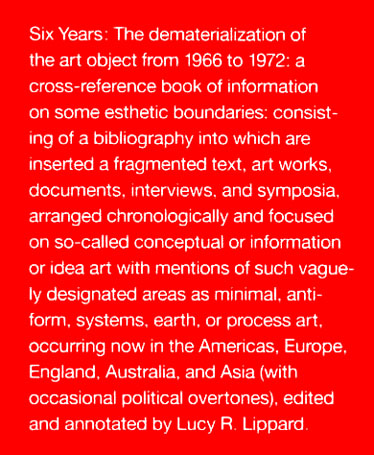
On the tenets of Conceptual art
Conceptual art, for me, means work in which the idea is paramount and the material form is secondary, lightweight, ephemeral, cheap, unpretentious and/or “dematerialized.” […] Conceptual artists gloried in speeding past the cumbersome established process of museum-sponsored exhibitions and catalogues by means of mail art, rapidly edited and published books of art, and other small-is-better strategies. […] [W]e saw “ultra-conceptual art” emerging from two directions: art as idea and art as action. […] Communication (but not community) and distribution (but not accessiblity) were inherent in Conceptual art. Although forms pointed toward democratic outreach, the content did not. However rebellious the escape attempts, most of the work remained art-referential, and neither economic nor aesthetic ties to the art world were fully severed. […] Verbal strategies enabled Conceptual art to be political, but not populist. Communication between people was subordinate to communication about communication. […] For the most part communication was perceived as distribution, and it was in this area that populist desires were raised but unfulfilled. Distribution was often built into the piece. […] Decentralization and internationalism were major aspects of the prevailing distribution strategies. […] The easily portable, easily communicated forms of Conceptual art made it possible for artists working ourside the major art centers to participated in the early stages of new ideas. […] Perhaps most important, Conceptualists indicated that the most exciting “art” might still be buried in social energies not yet recognized as art.
via http://linedandunlined.com/2008/11/04/flagged-passages-2-escape-attempts/
The World Without Us
December 29th, 2008

can’t wait to watch this
December 29th, 2008
sorry didn’t want to type the title so as not to give it away.
i saw this in the theaters today and when i suddenly realised what it was, i was like ‘woah shit’.
Iron Sky
December 28th, 2008
In 1945 Nazis went to the moon, in 2018 they are coming back.
The Comics Are Feeling the Pain of Print
December 27th, 2008

“Newspapers are declining,” he says. “For a syndicated cartoonist, that’s like finally making it to the major leagues and being told the stadiums are all closing, so there’s no place to play.”
http://www.nytimes.com/2008/12/28/business/media/28proto.html?_r=1
Xmas eve on 5th Ave
December 27th, 2008

Proudly powered by WordPress. Theme developed with WordPress Theme Generator.
Copyright © _dreams. All rights reserved.
Copyright © _dreams. All rights reserved.