
People We Couldn’t Sleep With
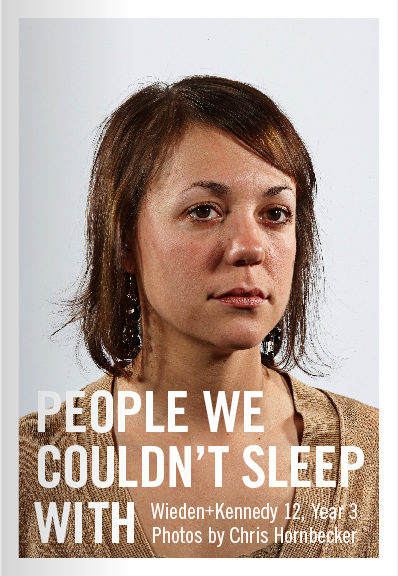
Upon entering the school, the students of WK12 were given one condition: they were not allowed to sleep with anyone in the agency.
Spread Firefox: Download Day
Cranbrook Commencement Address
This commencement address was delivered by Julie Lasky at the Cranbrook Academy of Art on May 9, 2008.
“Make it work,” on the other hand, is about deliberation; “make it work” recognizes the unlikelihood of perfection and the strong possibility of flawed performance. It’s based firmly in time; it represents limits. Most telling of all, it comes out of an age when remarkable athletes have been exposed as steroid users. This directive connects to a process, and the verb is constructive: “Make.” The items it alludes to are idiosyncratic and frequently lumpy articles of clothing — not perfectly machined Nike models or shoes. Sure, “Project Runway” is all about craft, but Tim Gunn could have used any number of catchphrases. This one really captures the ethos of craft, in both its material and mindful dimensions.
…
Don’t worry about categories or definitions like craft, design, or art. Philosophers and magazine editors are happy to hammer them out for you, and you have better things to do anyway. One is to develop as many areas of expertise as you can without watering down what you’re good at. Diversity is a huge asset in any career, especially when the economy is on the rocks.
read whole speech at Design Observer.
Rip-off of kenmeier.info.
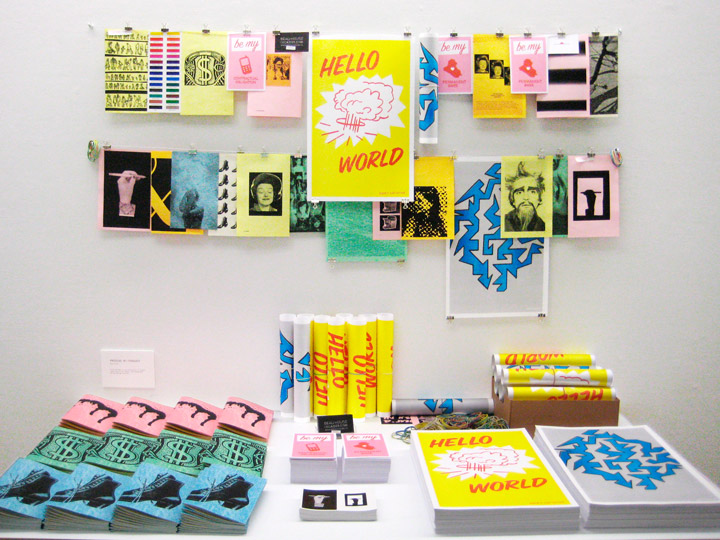
found this on kenmeier’s weblog.
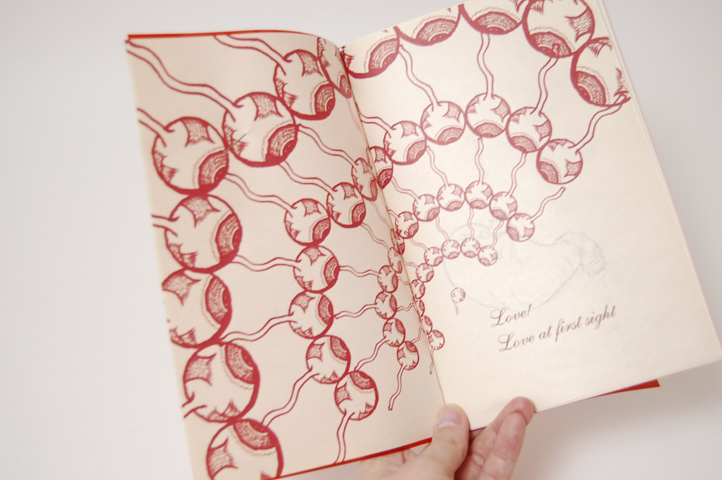
i’m recalling this from memory, but it kind of goes like this in the last page:
STEVE: Do you see your art as a supplant of your design, or do you see them as a whole?
DANIEL: My art is my design, and my design is my art.
STEVE: Then what do you call yourself?
DANIEL: Daniel Eatock.
Inside Gecko
Inside Gecko is a visualization program created by Satoshi Ueyama, made with Processing which shoes the reflow process of a browser while it translates the HTML code so as to present the page to the user.
Lost Alphabets


Chris Thompson
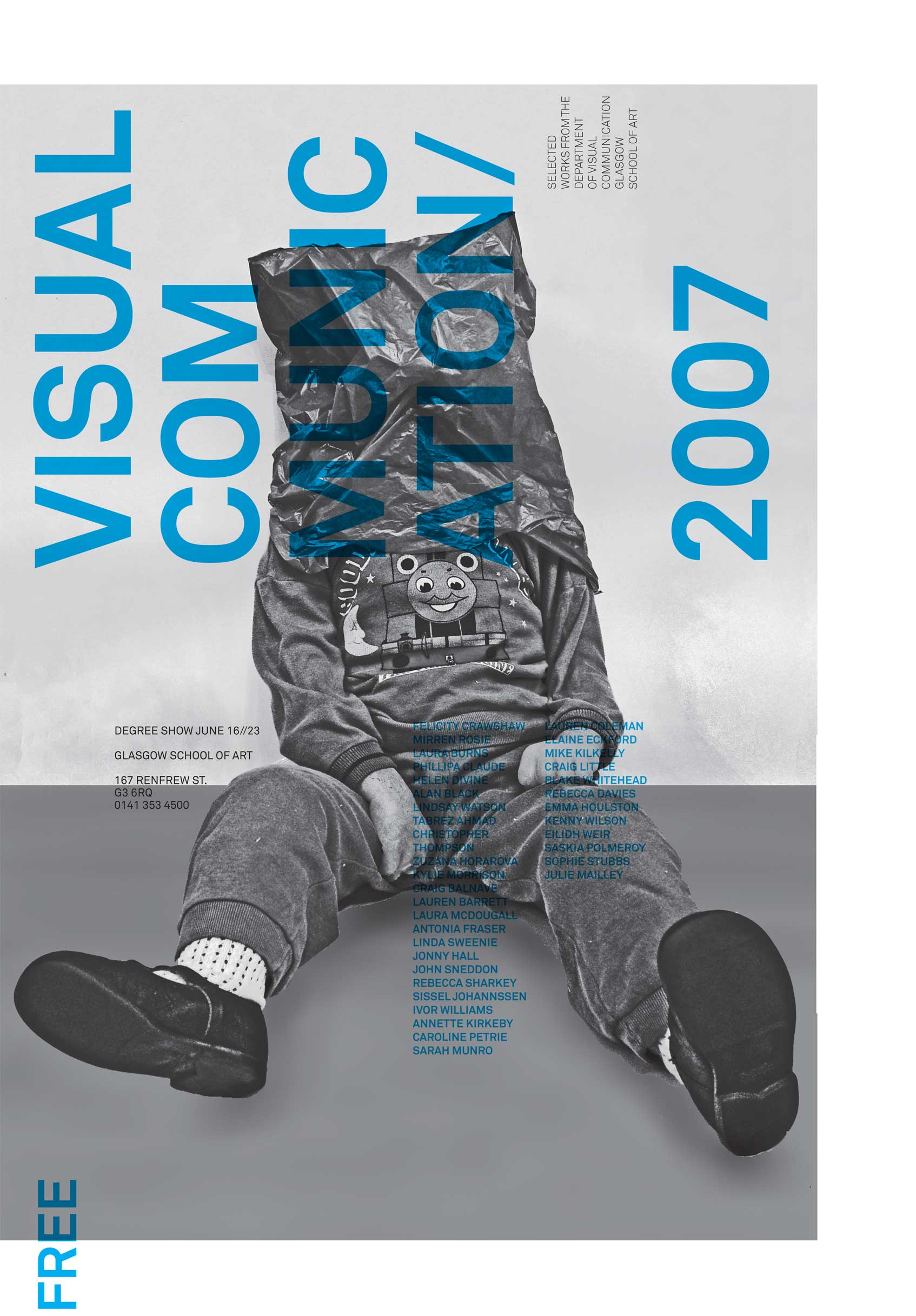
chris thompson has recently graduated from the glasgow school of art with first class honours, where he studied graphic design inside the department of visual communication.
his website is not based upon daniel eatocks format.
The Uncertainty Principle

In Tauba Auerbach’s works there is a recurring interest in the space between the sensical and non-sensical – in how meaning is translated through the help of fragile and frequently failing systems of signs and symbols. Language and logic both appear as porous (and potentially playful) in her works on paper, which have investigated such various elements of communication as semaphore, Morse, and binary programming language. In “The Uncertainty Principle”, Auerbach combines seven new drawings with five new photographs to address the constant diminishing presence of randomness – as a result of technology’s reductions and / or simulations of ‘the random’.
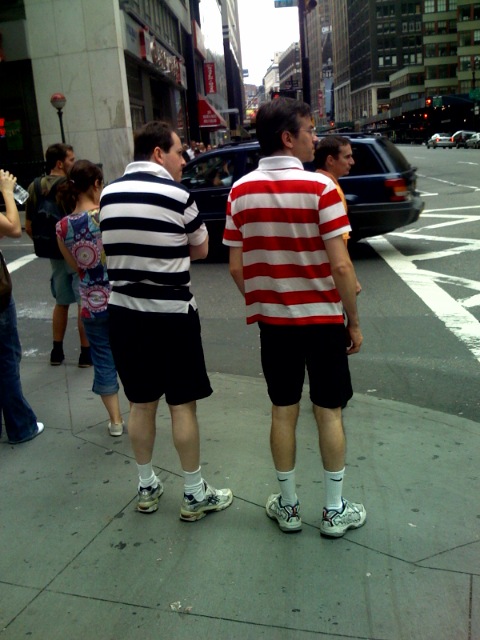
friends that dress alike


Logologos
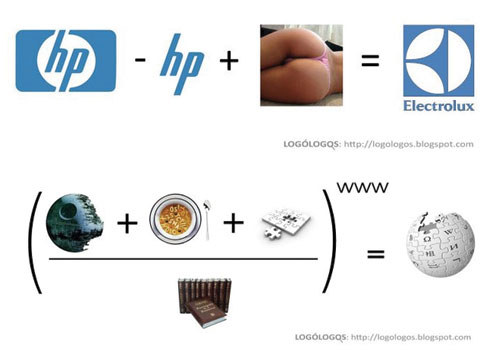
Math and arithmetic behind well known logos brought to us by Argentinian bloggers La Luna and Javier.
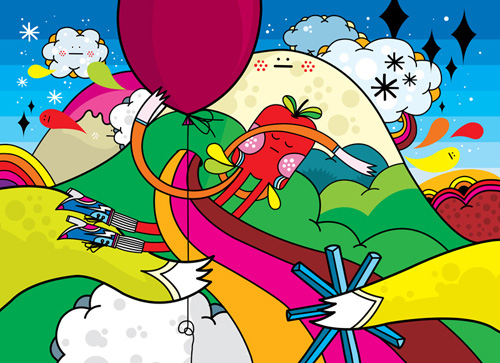
Biggest Drawing in the World

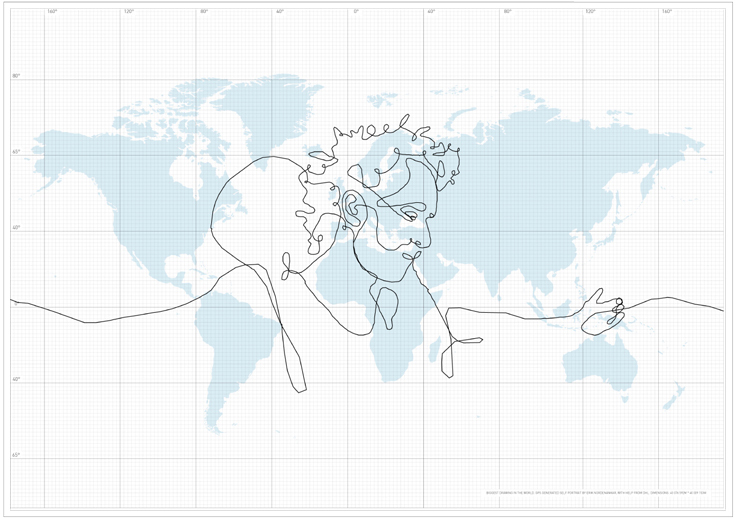
Reminiscence of Madad’s map project
Previous/Next
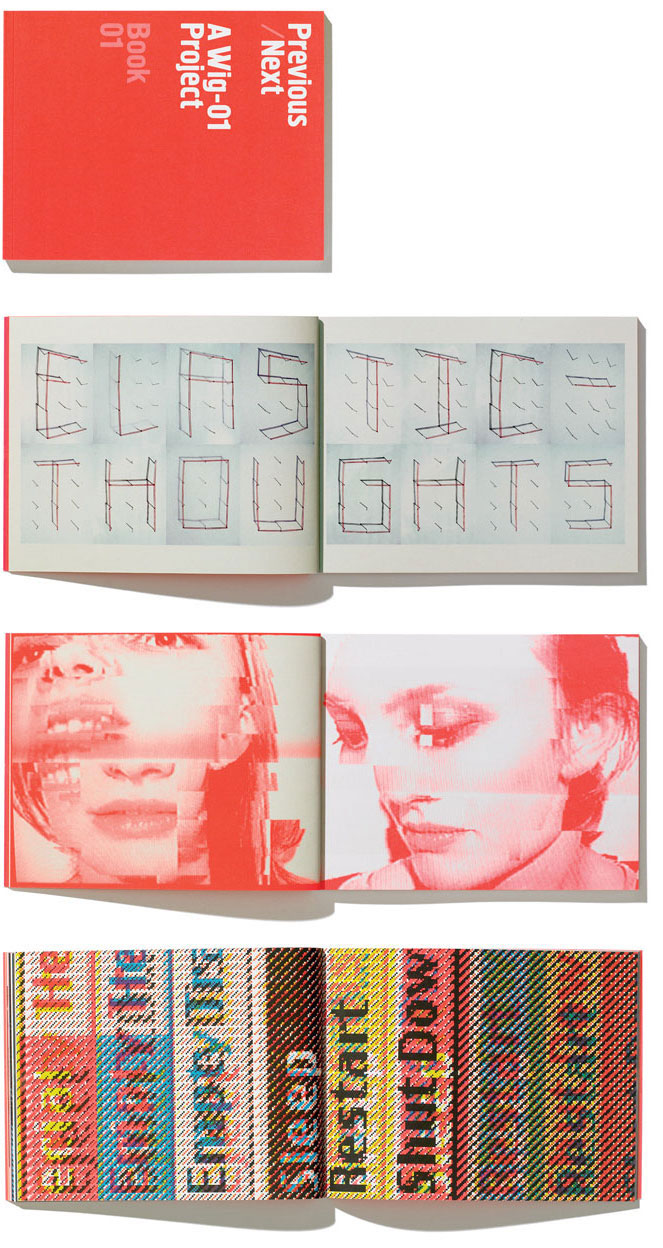

Multisensorial inspirations
Advanced Beauty from mate on Vimeo.
Alone in Tokyo HD from Philip Bloom on Vimeo.
SATI audiovisual : “Pic vert Attack” from Jesse Lucas on Vimeo.
flicflex concept from chriswoebken on Vimeo.
Brokenbeat Promo [05.03.08] from Accent Creative on Vimeo.
New Media
OLD MEDIA
The “old media” are newspapers & magazines, direct mail advertising, and radio & television. All are based on a number of assumptions:
* There are only a limited number of “players” in the market. The market entry cost is high. In some areas (TV & radio) there is a “natural” limit on the number of players.
* Along with this, Old Media are geographically limited. Radio and TV stations can only broadcast so far. International mail is slow, expensive and often not reliable.
* Communications are strictly one way. The content provider sends information to the consumer and the consumer sends money to the provider. There is no mechanism for a flow of either information or money in the opposite direction. The consumer is strictly passive.
* Providers have detailed and exact control of what the consumer sees or hears.
* Presentation is more important than content. Content and presentation cannot be separated. “The medium is the message”.
NEW MEDIA
When we look at the “new media” like the World Wide Web, we see the exact opposite of the “old media” assumptions:
* The number of players is unlimited. Entry cost is no more than a computer, a modem, and an Internet connection. There are no “natural” limits to the number of players.
* No place in the world is appreciably further away then any other place.
* Communication is inherently two- way. The consumer is active.
* Providers not only do not, they can not control exactly what the consumer sees.
* Content is more important than presentation. Content and presentation are separate. The medium is provided by the viewer; the message is provided by the creator.

Crispin’s Nike Loss Is Wieden’s Gain
Crispin Porter’s work:
http://adscam.typepad.com/my_weblog/2008/05/nike-nixes-cpb.html#comments
W+K’s self-initiated projects
Because W+K is an independently owned agency, it doesn’t have the luxuries, especially the bottomless pocketbooks, of the global conglomerates. What it does have, and what makes the agency a perfect fit for branching out into “branded content,” is its ingenuity and ability to take risks because of the lack of stockholders watching closely at every move the agency makes (Berger 2002).
When he first became interested in the idea, Wieden created an in-house entertainment division of his agency to “pursue projects that would be either funded by a client or produced by the agency itself” (Berger 2002). Shortly thereafter, W+K produced a book titled Cat Spelled Backwards Doesn’t Spell God: The dogs of Portland, which quickly “hit best-seller lists overseas” (Berger 2002).
After this first success, Wieden began developing other ideas to pair his clients with new media. Unfortunately, the only client willing to trust Wieden’s vision and risk financial loss was Nike, W+K’s cornerstone. With Nike, W+K partnered with Radical Media in 2001 to produce the Road to Paris, a documentary following Lance Armstrong’s race through the Tour de France, targeted specifically to cycling enthusiasts. In their Tokyo office, W+K experimented with music, commissioning original songs and music videos to be produced specifically for Nike advertisements. Because of the success and acceptance that W+K experienced with Nike music, they began working on launching their own record label to be debuted in the fall of 2003 (Berger 2002).
http://www.ciadvertising.org/sa/spring_03/382j/aclaire/Future.html
Nike branding history
due to my upcoming internship at W+K with the Nike creative team, i decided to do some research on how W+K has contributed to the success of Nike. The website sucks ass but the info is short and sweet.

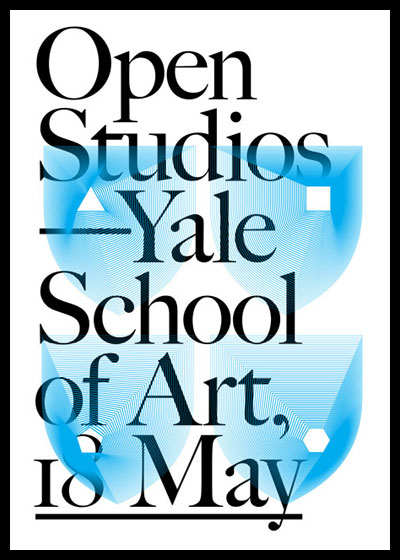
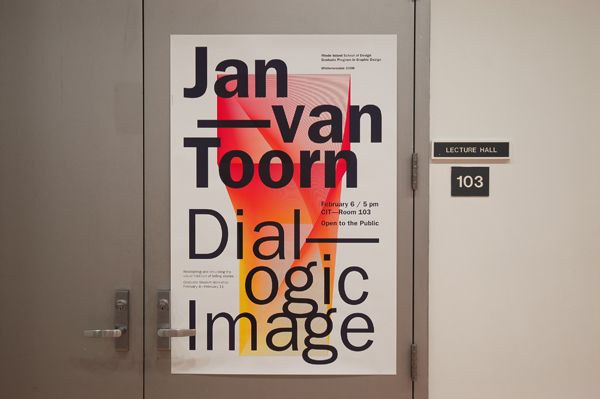
RISD vs YALE
Ken Meier: Yale
Hoon Kim: RISD

What are you?

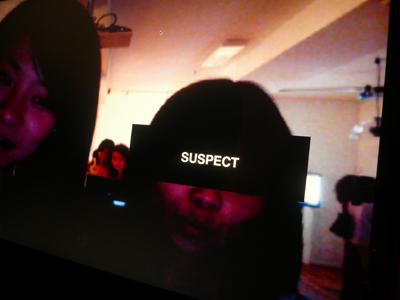
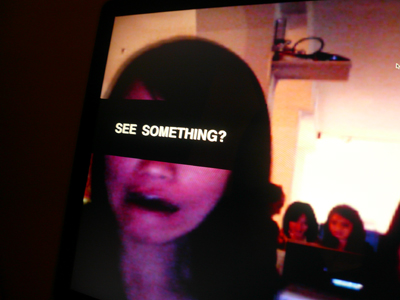
Parsons’s Design and Technology & Communication Design thesis show.
Copyright © _dreams. All rights reserved.